


Sochi Hotel Market: Figures, Trends and the State of the Industry in 2024–2025
An analytical overview: accommodation facilities, international chains, tourist flow and investment
Introduction
Sochi is Russia's largest resort and one of the country's key domestic tourism hubs. Over the twelve years since the 2014 Winter Olympics, the city has undergone a radical transformation of its hotel infrastructure: a modern mountain cluster, coastal five-star hotels of international standard, and a renewed sanatorium-and-resort base have all emerged. Since 2022, however, the market has faced a major external challenge — the mass exit of international hotel operators — which forced the industry to adapt and accelerated the development of domestic brands.
This article brings together current data on the number and structure of Sochi's accommodation stock, examines the state of international and Russian hotel chains, and reviews tourist flow dynamics, industry revenues and ongoing investment plans. All figures are backed by references to official sources: the press service of the Sochi administration, TASS, RBC, industry portals and publications by the Krasnodar Region Ministry of Resorts, Tourism and the Olympic Heritage.
Accommodation structure: from 705 facilities in 2016 to 2,300 in 2024
While at the end of the post-Olympic period in 2016 Sochi listed 705 classified accommodation facilities (including 66 sanatoriums, 20 boarding houses and recreation centres, 1 balneological clinic and 618 hotels), the picture has changed dramatically over the past eight years. According to the Sochi municipality and the Krasnodar Region Ministry of Resorts, the municipal area now hosts more than 2,300 accommodation facilities with a total capacity of about 150,000 beds.
Key indicators for 2024:
- Total room stock in Sochi in summer 2024 — 75,580 rooms.
- During the high season, guests were hosted by 56 sanatoriums and boarding houses with medical treatment.
- The five-star room stock exceeded 3,052 rooms — over the first nine months of 2024 it grew by almost 2%, or 59 rooms.
- From January to September 2024 alone, 19 new accommodation facilities opened in Sochi; three of them received the "5-star" rating, adding 389 rooms.
- Average occupancy of collective accommodation facilities from January to August 2024 reached 77.9%; during the calendar summer — 89%; in August — a record 93.2%.
The Krasnodar Region as a whole has around 11,000 accommodation facilities, and a substantial share of them is concentrated in Sochi. The city remains the undisputed leader of the Russian resort market by density and quality of hotel infrastructure.
The mountain cluster: leading Russia in room-stock density
A special place in Sochi's hotel geography belongs to the Krasnaya Polyana ski cluster, which comprises three major resorts: Rosa Khutor, Krasnaya Polyana Resort and Gazprom Polyana. According to consultancy NF Group (research published in February 2025), the Sochi mountain cluster has the highest room-supply coefficient among all ski resorts in Russia — 35 rooms per kilometre of ski trail. This is significantly above the Russian average of 24 rooms per kilometre.
The Sochi cluster also leads by trail length: 171 km out of Russia's total of 1,300 km of ski trails. Flagship hotels in the cluster include Mövenpick Krasnaya Polyana, Sochi Marriott Krasnaya Polyana, Rixos Krasnaya Polyana, Courtyard by Marriott, Ibis Styles, Novotel Resort & Spa, and five hotels of the AZIMUT chain (including VALSET Apartments and AZIMUT FREESTYLE Rosa Khutor 3*). Rosa Khutor resort offers guests both valley-level hotels (560 m) and ski-in/ski-out properties at 1,170 m elevation.
Rosa Village alone — a modern hotel complex on the territory of the Mountain Olympic Village — offers 364 rooms across more than 10 accommodation types. This gives a sense of the scale of facilities built in the mountains over the past decade.
International hotel chains in Sochi: history, current status and transformation
Which international brands operate in Sochi
By the start of 2022, Sochi hosted hotels from at least six of the world's largest hotel groups — a record figure for a Russian regional resort. They included:
- Accor (France) — Swissôtel Resort Sochi Kamelia 5* (opened in 2014 on the site of the legendary "Inturist" boarding house), Pullman Sochi Centre, Mercure Sochi Centre, Mövenpick Krasnaya Polyana, Novotel Resort & Spa Krasnaya Polyana, Ibis Styles and others — nine hotels in Sochi under the group's brands in total.
- Radisson Hotel Group (formerly Carlson Rezidor) — five hotels in Sochi, including the historic Radisson Lazurnaya Hotel Sochi, opened back in 1996 and considered the city's first international chain hotel. Ahead of the 2014 Olympics the group opened five more hotels across various price segments.
- Marriott International (USA) — Sochi Marriott Krasnaya Polyana, Courtyard by Marriott Sochi Krasnaya Polyana, Courtyard by Marriott Sochi Plaza.
- Hyatt Hotels Corporation (USA) — Hyatt Regency Sochi.
- Rixos Hotels (Turkey) — Rixos Krasnaya Polyana Sochi 5* with 114 rooms, located in Krasnaya Polyana.
- Louvre Hotels Group (France) — properties under the Golden Tulip and Tulip Inn brands in the mountain cluster and the Imeretinskaya Lowland.
What changed after February 2022
Following the start of the special military operation in Ukraine, a number of the world's largest hotel operators announced a suspension of development in Russia and a freeze on new projects. This affected a significant share of Sochi's hotels — but no physical closures took place: most of the buildings are owned by Russian companies, and the chains merely walked away from direct management and new investment.
Current status of the key operators:
- Accor — suspended the opening of new hotels in Russia but kept management of existing properties via its Russian subsidiary. As of May 2026, Swissôtel Resort Sochi Kamelia, Mövenpick Krasnaya Polyana and Pullman Sochi Centre continue to operate under the group's brands in Sochi.
- Marriott International — suspended investment and new projects in Russia in March 2022; the properties continue to operate.
- Hyatt — suspended all partnership relations with Russian companies. Hyatt Regency Sochi continues to operate, but without new projects from the chain.
- IHG (Hilton, Holiday Inn, etc.) — also announced a suspension of investment; properties in Russia are gradually rebranding.
- Radisson Hotel Group — officially continued operations in all Russian hotels, including the five properties in Sochi.
- Rixos Hotels — likewise continues to operate in Russia without restrictions.
The hotels physically remain in place, but some international brands no longer manage them directly, and a number of properties have either changed signage to Russian brands or are in the process of doing so.
The rise of Russian hotel brands
In parallel with the partial retreat of international chains, Russian hotel operators have grown rapidly in Sochi. Among the most notable are AZIMUT Hotels (five properties in Rosa Khutor, including the VALSET buildings), Cosmos Hotel Group, the Bridge Resort chain, the Imeretinsky group and Sochi Park Hotel. The Krasnaya Polyana resort is developing its own "Polyana 1389" and "Grand Hotel Polyana" brands. This brand-substitution process in the hotel industry is one of the central trends of 2023–2025.
Tourist flow and financial performance
Tourist flow dynamics
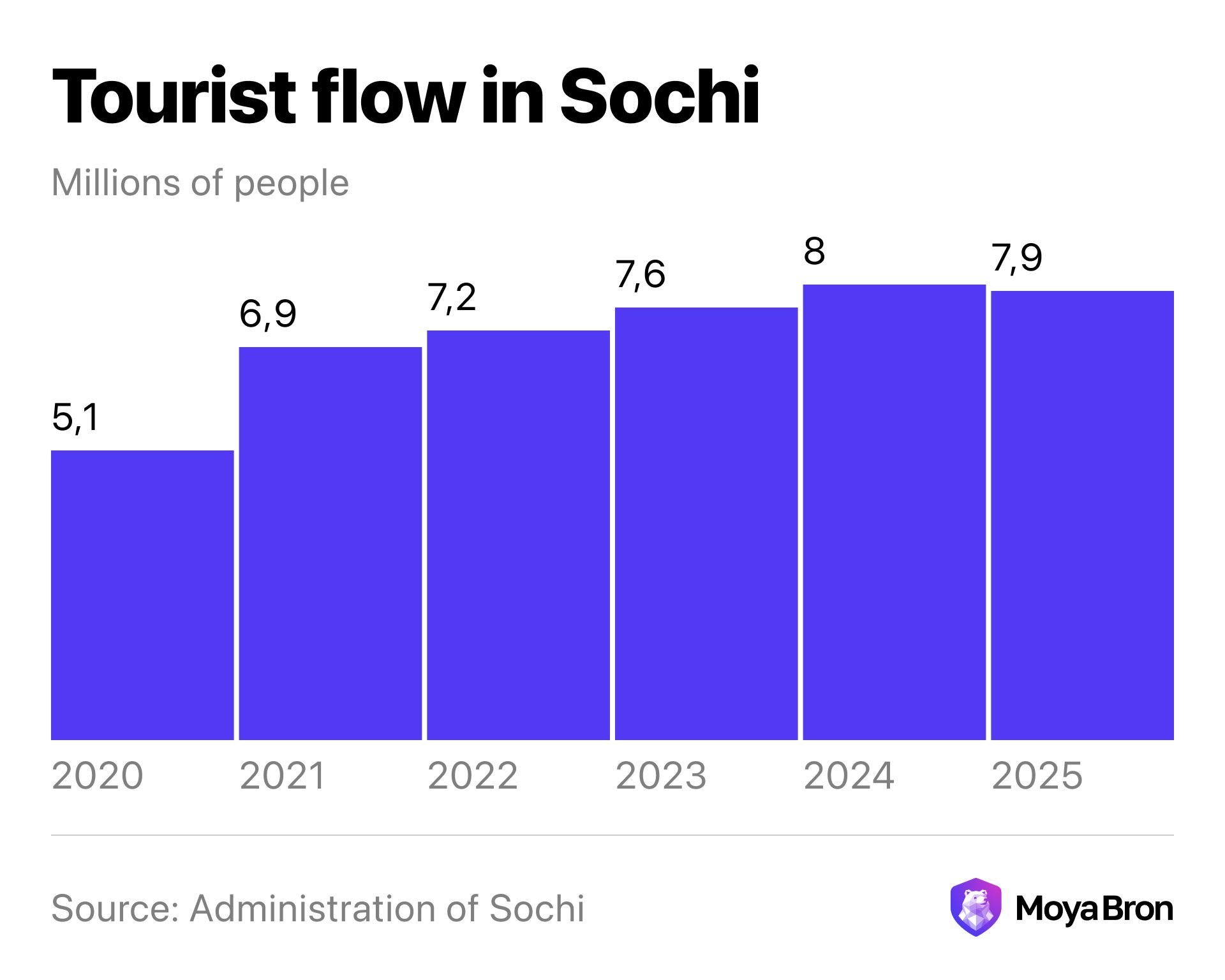
Sochi remains the most-visited resort in Russia. Tourist-flow dynamics over recent years:
- 2022 — 7.2 million tourists.
- 2023 — about 7.6 million tourists (+5.8% versus 2022). The administration's September–October 2023 forecast of 7.4 million was exceeded by year-end.
- 2024 — a record ~8 million people (+400,000 versus 2023); around 175,000 tourists were present in the city at any one time in summer.
- 2025 — about 7.9 million people, essentially matching the 2024 record. This represents roughly 40% of the Krasnodar Region's total tourist flow.
August traditionally remains the most-visited month: in 2024 room-stock occupancy hit a record 93.2%, with 1.13 million people visiting the resort in that single month. The mountain cluster also shows confident growth: mountain tourist flow grew by an average of 10% in 2024, and summer occupancy reached 80% — twice the level of five years earlier.
Industry revenues
The volume of work and services delivered by Sochi's resort-and-tourism organisations exceeded 69.1 billion roubles in 2024, and by summer 2025 — according to the municipality — had grown to 77.3 billion roubles. For comparison: in 2015 the industry generated 30.7 billion roubles, meaning turnover has more than 2.5× over the decade. Sochi's share of the Krasnodar Region's resort-and-tourism services is estimated at 53–56%, confirming the city's status as the key centre of the industry both regionally and nationally.
Resort fee and tourist tax
From 16 July 2018, a resort fee was in force in Sochi as a pilot federal experiment. The rate changed several times:
- From 16 July 2018 to 31 May 2020 — 10 roubles per night.
- From 1 June 2020 to 31 December 2020 — 0 roubles per night (suspension during the COVID-19 pandemic).
- From 1 January 2021 to 31 December 2021 — 10 roubles per night again.
- From 1 January 2022 to 31 December 2024 — 50 roubles per night.
Over the seven years of the experiment Sochi collected around 1.9 billion roubles in resort fees. For the first 11 months of 2024 receipts amounted to 533.6 million roubles — 7% higher than in the same period of 2023. The funds went to resort-infrastructure improvements: the embankment of the Psakhe river, the "Friendship of Peoples" and "Komsomolsky" squares, lighting on the Mzymta embankment and CCTV equipment for beaches.
From 1 January 2025 the resort fee was replaced by a tourist tax at a rate of 1% of accommodation cost — a decision made by Sochi City Council deputies in October 2024. The new tax is no longer an experiment but a permanent rule.
Beach and service infrastructure
As of 2016, Sochi had 183 beach areas. By 2024 the picture had shifted: in the 2024 swimming season 170 pebble beaches with a total length of about 40 km were in operation. Over the course of 2024, 51 beaches passed federal classification meeting national quality standards, while 42 beaches received the top "Blue Flag" mark. The picture improved noticeably in 2025: "Blue Flags" were awarded to 51 beaches (21% more than the previous year), and federal classification was passed by 67 beaches in total.
Particular attention is paid to accessibility: 40 beach areas across all districts of the resort are equipped for people with disabilities and limited mobility, with 65 mobile ramps installed and swimming wheelchairs purchased. From 1 November, 33 winter beaches operate in the city for walks and off-season recreation.
According to the Sochi municipality, the city also hosts recreation centres, around 70 excursion companies and more than 100 tourist attractions.
Investment plans and outlook to 2033
The future of Sochi's resort industry is shaped by the city's Socio-Economic Development Strategy through 2035, adopted in 2023, which positions Sochi as "Russia's largest and most advanced sustainable resort" with a year-round tourism product in demand.
Key indicators of the investment programme (as of January 2026):
- Sochi's investment portfolio for 2025–2033 includes 60 major projects with a total volume of more than 650 billion roubles; around 73% of the funds go to the sanatorium-and-resort sector.
- On top of the existing nearly 76,000 rooms (capacity of about 150,000 people), another 27,000 new hotel rooms are planned by 2033.
- Delivery of the programme will create more than 25,000 new jobs.
Development is unfolding along several lines: expansion of the mountain cluster, reconstruction of the Soviet-era sanatorium base, the appearance of new accommodation formats (apart-hotels, medical tourism, wellness resorts) and the modernisation of coastal infrastructure in the Imeretinskaya Lowland.
Conclusion
Sochi's hotel market has made a qualitative leap over the past decade: the number of classified accommodation facilities has tripled — from 705 in 2016 to more than 2,300 in 2024 — while the total room stock has reached 75,500. The city retains the status of Russia's largest resort and continues to grow even amid the geopolitical changes of 2022.
The main trend of the past three years is the parallel development of two processes. On the one hand, some international hotel operators (Accor, Marriott, Hyatt, IHG) have suspended direct management and new investment, leaving the physical properties under effective Russian control. On the other, Radisson and Rixos continue full operations, while Russian brands AZIMUT, Cosmos, Bridge Resort and the mountain resorts' in-house brands are actively expanding their market share.
Tourist flow has plateaued at around 8 million people a year: 2025 (~7.9 million) essentially matched the 2024 record, and at an average room-stock occupancy of around 85% the administration is deliberately not chasing further quantity records — instead shifting the focus to quality of accommodation and service. The city's budget continues to grow, while the updated 650-billion-rouble investment portfolio sets the agenda for the coming decade. For travellers choosing a hotel in Sochi this means a broad variety of options — from historic sanatoriums to modern five-star resorts and world-class mountain hotels. For the industry as a whole, it means continued qualitative development and the gradual localisation of brands while maintaining a high service standard.
About the author

Sources
All the figures cited in the article are confirmed by publications of official and authoritative industry sources:
- City of Sochi Administration. "Sochi expects to host around 8 million tourists in 2024" — sochi.ru
- RBC Krasnodar. "Sochi's five-star room stock exceeded 3,000 in 2024", October 2024 — kuban.rbc.ru
- RBC Krasnodar. "Sochi resort-fee receipts grew 7% over 11 months of 2024", December 2024 — kuban.rbc.ru
- RBC Krasnodar. "Sochi's ski cluster leads Russia in room-stock density", February 2025 — kuban.rbc.ru
- TASS. "Sochi tourist flow in 2023 expected at 7.4 million people", October 2023 — tass.ru
- Delovaya Gazeta. Yug. "Sochi room stock booked at 73% for the next three months", July 2025 — dg-yug.ru
- Kubanskie Novosti. "More than 470 million roubles of tourist tax collected in Sochi", October 2025 — kubnews.ru
- Sochi City Council. "Sochi 2024 budget and development strategy through 2035" — gs-sochi.ru
- City of Sochi Administration. "Resort fee" — sochi.ru
- RUSSPASS Journal. "International hotel chains: who operates in Russia?", 2024 — mag.russpass.ru
- RATA-news. "Will hotels of the brands that left Russia keep operating?", March 2022 — ratanews.ru
- PRIME / 1prime. "What awaits hotels of international brands that left Russia", March 2022 — 1prime.ru
- HotelierNews. "Sochi's five-star room stock exceeded 3,000 rooms", October 2024 — hoteliernews.ru
- Krasnaya Polyana Resort (official site). "Hotels" section — krasnayapolyanaresort.ru
- Swissôtel Resort Sochi Kamelia (official site) — swissotelsochi.ru
© moyabron.ru — based on publicly available data from official sources. Data current as of 2024–2025. Prepared: May 2026.